Amino acids are the fundamental building blocks of proteins and show a unique combination of physical and chemical (physicochemical) properties because they contain both an amino group and a carboxyl group in the same molecule.
These properties, such as solubility, melting point, optical activity, zwitterion formation, and acid–base behavior, determine how amino acids behave in aqueous solutions and how they participate in biochemical reactions and protein structure.
In this guide, you will learn the important physio chemical properties of amino acids with simple explanations and examples useful for MBBS, BSc, MSc, and paramedical students.
We will also discuss key reactions of amino acids that commonly appear in practical biochemistry and university examinations, such as Sanger’s reagent reaction, dansyl chloride reaction, and reaction with nitrous acid.

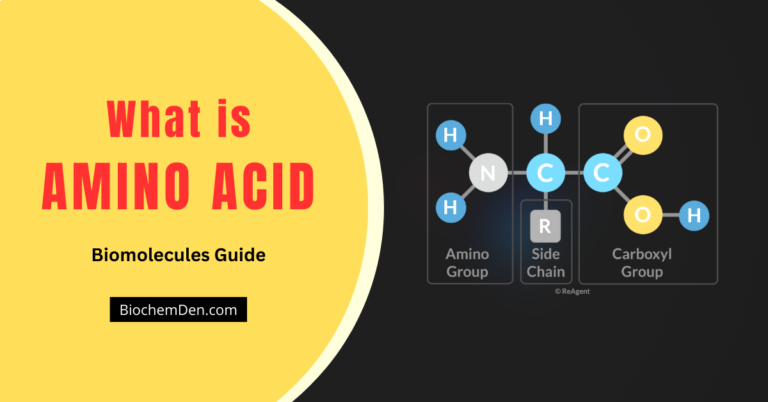
An amino acid is an organic molecule with an amino group (NH₂ ) and a carboxyl group (COOH). The most frequent and of the greatest interest are those amino acids that form part of proteins.
Two amino acids are combined in a condensation reaction between the amino group and the carboxyl group of another amino acid, releasing one molecule of water and forming an amide bond. This is called a peptide bond.
These two amino acids form a dipeptide. If you add a third amino acid, one tripeptide is formed, and so on, to create a polypeptide. This reaction occurs naturally within cells, in ribosomes.
All components of the protein amino acids are L-alpha-amino acids. This means that the amino group is attached to the carbon adjacent to the carboxyl group (alpha carbon), or, in other words, both the carboxyl and the amino are attached to the same carbon; this one-unit alpha carbon-hydrogen and a chain (usually called a side chain or radical R) of the variable structure determine the identity and properties of each of the different amino acids.
The human body is made up of 20 percent protein. Proteins play a key role in almost all biological processes. Amino acids are the basis of proteins.
Since many of our cells, muscles, and tissues are composed of amino acids, they perform many important functions in our body: they give the cell not only its structure but are also responsible for transporting and storing all kinds of vital nutrients.
Amino acids influence the functions of organs, glands, tendons, and arteries.
This topic included the complete list of the physiochemical properties of amino acids.
General Physical Properties of Amino Acids
Amino acids share several common physical properties because of their ionic nature and crystalline solid state. These general physical properties are frequently asked as short notes and objective questions in exams.
- Amino acids are colorless, crystalline solids that resemble inorganic salts rather than typical organic compounds.
- They have relatively high melting points, often above 200 °C, because of strong ionic interactions in the zwitterionic form.
- Most amino acids are soluble in water and poorly soluble in non‑polar organic solvents; solubility depends on the nature of the side chain (R‑group) and the pH of the solution.
- At physiological pH, amino acids exist predominantly as zwitterions, with a positively charged ammonium group and a negatively charged carboxylate group, giving an overall neutral molecule.
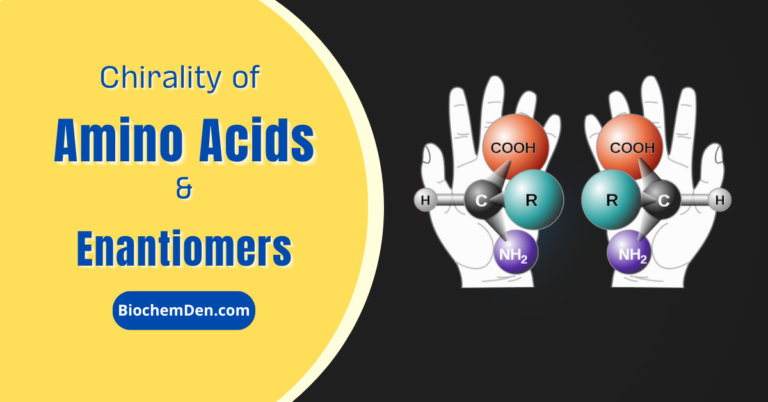
- All standard amino acids except glycine are optically active because they contain at least one chiral (asymmetric) carbon atom and can rotate plane‑polarized light.
What Are Physicochemical Properties?
Physicochemical (or physico-chemical) properties are the combined physical and chemical characteristics of a compound that determine its behavior in different environments.
For amino acids, these properties include their solubility, melting point, taste, crystalline nature, optical properties, zwitterionic nature, acid–base properties, and characteristic chemical reactions.
Because amino acids exist mainly as zwitterions at physiological pH, they behave more like ionic salts than typical organic molecules, which explains their high melting points and good solubility in water.
Understanding these physicochemical properties of amino acids is essential to explain protein structure, protein folding, and the chemical reactions of amino acids in metabolism.
1. Solubility of Amino Acids
Solubility is one of the most important physical properties of amino acids and is influenced by the charge and polarity of the side chain. Most amino acids are readily soluble in water but have low solubility in nonpolar organic solvents like benzene or ether.
- Amino acids with polar or charged side chains (for example, lysine, arginine, aspartate, glutamate) are highly soluble in water because they can form strong hydrogen bonds and ionic interactions with water molecules.
- Amino acids with nonpolar side chains (for example, valine, leucine, isoleucine, and phenylalanine) are less soluble in water and more soluble in hydrophobic environments, which plays a major role in protein folding.
- Solubility also depends on pH, because the ionization state of the amino and carboxyl groups changes with the pH of the solvent, altering the net charge on the amino acid.
2. Melting Point of Amino Acids
Amino acids show unusually high melting points compared to many other organic molecules due to their zwitterionic nature. When heated to high temperatures, they decompose rather than boil like typical organic compounds.
- The melting points of most amino acids are greater than 200 °C; they often decompose on further heating.
- High melting points reflect strong electrostatic attraction between the oppositely charged groups within and between amino acid zwitterions in the crystal lattice.
- This behavior supports the concept that amino acids in the solid state exist mainly in the zwitterionic form rather than as simple neutral molecules.
3. Taste and Other Sensory Properties
Some amino acids have characteristic tastes, which is an interesting but exam‑relevant physical property. This property is not very important for protein chemistry but is commonly mentioned in short notes.
- Certain amino acids, such as glycine, alanine, and valine, have a sweet taste, while others like leucine are nearly tasteless.
- Basic amino acids like arginine and some branched‑chain amino acids such as isoleucine may have a bitter taste.
4. Optical Properties of Amino Acids
Optical properties of amino acids refer to their ability to rotate plane‑polarized light due to the presence of chiral centers. This is a key physicochemical property used in stereochemistry and in the study of protein structure.
- All standard amino acids except glycine are optically active because they contain at least one asymmetric (chiral) carbon atom.
- Amino acids exist in two optical isomers, D and L forms, but proteins in living organisms are almost exclusively composed of L-amino acids.
- The optical rotation depends on the nature of the side chain and the configuration around the chiral carbon, which is important for enzyme specificity and protein function.
5. Zwitterion and Isoelectric Point
Amino acids show a special ionic form called a “zwitterion” and have a characteristic “isoelectric point,” which are central topics under the acid–base properties of amino acids. These concepts explain many physical and chemical properties of amino acids, including solubility and behavior in electric fields.
- In aqueous solution, particularly around neutral pH, an amino acid exists mainly as a zwitterion, in which the carboxyl group is ionized to a carboxylate ion (–COO⁻) and the amino group is protonated to an ammonium ion (–NH₃⁺), giving an overall neutral molecule.
- The isoelectric point (pI) of an amino acid is the pH at which the amino acid carries no net charge and does not move in an electric field; at this pH, amino acids are least soluble in water.
- The acid–base properties and isoelectric point depend on the pKa values of the carboxyl and amino groups and, for ionizable side chains, the pKa of the R‑group as well.
6. Titration Curve of Glycine
Glycine is often used as a model amino acid to illustrate titration curves and acid–base behavior. Its titration curve shows two main buffering regions corresponding to the ionization of the carboxyl and amino groups.
- When glycine is titrated with a strong base, the first buffering region appears around the pKa of the carboxyl group, where the –COOH group is deprotonated to –COO⁻.
- The second buffering region corresponds to the deprotonation of the ammonium group (–NH₃⁺ to –NH₂), and the midpoint between the two pKa values gives the isoelectric point of glycine.
- The titration curve of glycine helps students understand the acid–base behavior of amino acids, the concept of isoelectric point, and buffering capacity.
Chemical Properties (Chemical Reactions of Amino Acids)
Chemical properties of amino acids arise from their functional groups: the amino group, carboxyl group, and side‑chain (R‑group) functional groups. These chemical reactions of amino acids are often used in qualitative tests, peptide synthesis, and structural analysis of proteins.
Broadly, the chemical properties of amino acids include:
- acid–base behaviour (amphoteric nature)
- formation of salts and esters
- peptide bond formation and acylation
- reactions with ninhydrin and other colour reagents
- specific reactions with reagents such as Sanger’s reagent, dansyl chloride, and nitrous acid.
Acid–Base Behaviour and Amphoteric Nature
Because amino acids contain both acidic and basic groups, they are amphoteric and can act as either acids or bases depending on the pH. This acid–base behavior of amino acids is fundamental to their role in biological buffers and protein charge.
- In acidic solution, amino acids accept protons and exist largely in the cationic form with a positively charged ammonium group.
- In alkaline solution, amino acids donate protons and exist largely in the anionic form with a negatively charged carboxylate group.
- Around the isoelectric point, amino acids exist predominantly as zwitterions with no net charge, making them amphoteric and able to react with both acids and bases.
Here are the chemical reactions of amino acids due to carboxyl and amino groups
I) Due to the Carboxyl group
a) Decarboxylation
The amino acids will undergo alpha decarboxylation to form the corresponding “amines.” Thus, important amines are produced from amino acids.
- Histidine –> Histamine + CO2
- Tyrosine –> Tyramine + CO₂
- Tryptophan –> Tryptamine + CO₂
- Lysine –> Cadaverine + CO₂
- Glutamic acid –> Gamma Amino Butyric Acid (GABA) + CO₂
b) Reaction with Alkalies (Salt formation)
The carboxyl group of amino acids can release an H⁺ ion with the formation of carboxylate (COO⁻) ions. These may be neutralized by cations like Na⁺ and Ca²⁺ to form salts. Thus, amino acids react with alkalies to form “salts.”

c) Reaction with Alcohols (Esterification)
When the amino acids are reacted with alcohol to form an “ester.” The esters are volatile, in contrast to the form of amino acids.

d) Reaction with Amines
An amino acid reacts with amines to form “amides.”

II) Due to the amino group
a) Reaction with Mineral acids (Salt formation)
When the amino acids are treated with mineral acids (like HCl), they form “acid salts.”
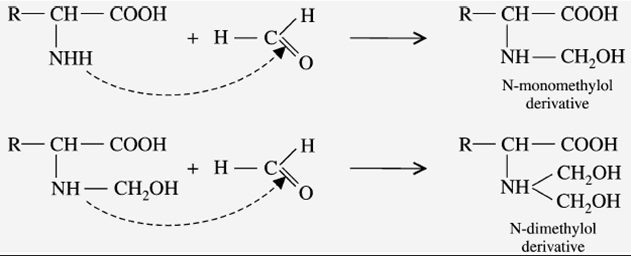
b) Reaction with Formaldehyde
When the amino acid reacts with two molecules of formaldehyde, it forms an “N-dimethylol derivative” (hydroxy-methyl derivative). This reaction is done in two steps. These derivatives are insoluble in water and resistant to attack by microorganisms.
c) Reaction with Benzaldehyde
When the amino acid reacts with benzaldehyde, it gives “Schiff’s base.”

d) Reaction with Nitrous acid (Van Slyke reaction)
Reaction of amino acids with nitrous acid is another classic chemical property used in qualitative analysis. Primary amino groups react with nitrous acid to release nitrogen gas and form corresponding hydroxy acids.

- When an α‑amino acid reacts with nitrous acid, the amino group is replaced by a hydroxyl group, producing an α‑hydroxy acid with the evolution of nitrogen gas and water.
- This reaction is used to study the chemical nature of amino acids and is also relevant in some metabolic pathways involving deamination.
- The reaction of amino acid with nitrous acid (or amino acid reactions with nitrous acid) is often mentioned under chemical reactions of amino acids in biochemistry textbooks.
e) Reaction with Sanger’s reagent
Sanger’s reagent reaction is a specific chemical reaction of amino acids used to identify the N‑terminal amino acid in a peptide or protein. Sanger’s reagent is 1‑fluoro‑2,4‑dinitrobenzene (FDNB).
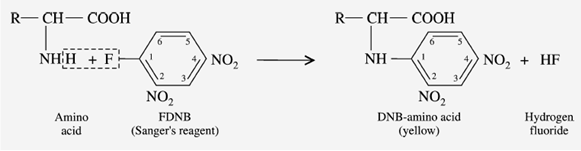
- Sanger’s reagent reacts with the free amino group of an amino acid or the N‑terminal amino group of a peptide under mild alkaline conditions to form a dinitrophenyl (DNP) derivative.
- After hydrolysis of the peptide, the DNP‑amino acid derivative can be separated and identified, revealing the N‑terminal amino acid.
- This Sanger’s reagent reaction with amino acid was historically important for determining the amino acid sequence of proteins and is often asked in exams as Sanger’s reaction or FDNB reaction with amino acids.
f) Reaction with DANSYl Chloride
The Dansyl chloride reaction is another important method used to identify the N-terminal amino acid in peptides and proteins. Dansyl chloride (5‑dimethylaminonaphthalene‑1‑sulfonyl chloride) reacts with amino acids to form fluorescent derivatives.
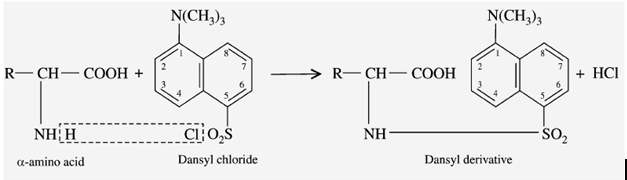
- Dansyl chloride reacts with the free amino group of amino acids or peptides to form a highly fluorescent dansyl‑amino acid derivative, which can be detected with high sensitivity.
- After hydrolysis of the peptide, the dansyl‑amino acid can be separated by chromatography and identified by its fluorescence, allowing determination of the N‑terminal amino acid.
- The dansyl chloride reaction with amino acid is frequently combined with other chemical reactions of amino acids to study protein structure and is a common exam question.
g) Reaction with acylating agents (Acylation)
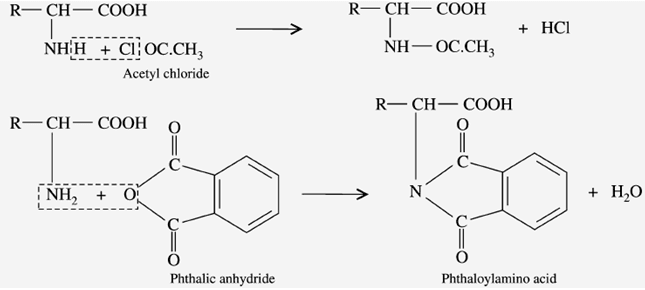
Acylation of amino acids is the reaction in which the amino group is acylated by an acid chloride or anhydride, forming N‑acyl amino acids or peptides. This reaction is an important step in peptide synthesis and modification of protein structure.
- In acylation, the free amino group of an amino acid reacts with an acylating agent (such as acetic anhydride) to form an N‑acyl derivative, often decreasing the basicity of the amino group.
- Acylation of amino acids is widely used in laboratory synthesis of peptides and in protecting group strategies in organic synthesis.
When the amino acids react with acid chloride and acid anhydride (phthalic anhydride) in an alkaline medium, it gives “phthaloyl amino acid.”
c) Due to amino & carboxyl group
Ninhydrin reaction
The ninhydrin test is a classic qualitative test for the detection of amino acids and proteins. It is included under the chemical properties of amino acids because it involves oxidative deamination and decarboxylation of the amino acid.
- When amino acids are heated with ninhydrin reagent, most α‑amino acids give a deep blue or purple colour, known as Ruhemann’s purple, indicating the presence of free amino groups.
- Proline and hydroxyproline, which contain secondary amino groups, yield a yellow color with ninhydrin instead of the typical violet colour.
- The ninhydrin reaction is widely used in chromatography and biochemical tests to detect and quantify amino acids and peptides.
Step 1:
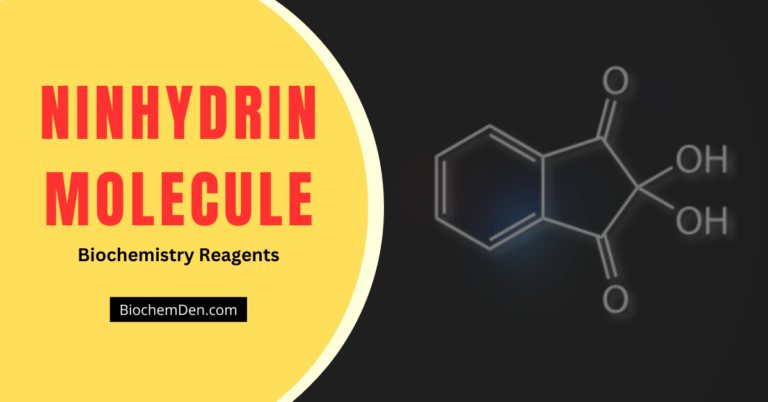
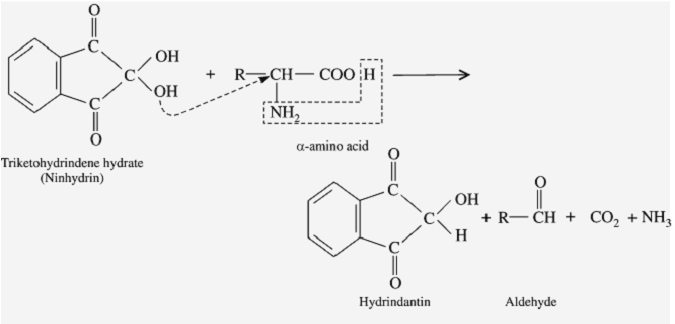
Ninhydrin (=indane 1,2,3-trione hydrate) is a powerful oxidizing agent and causes oxidative decarboxylation of α-amino acids, producing CO₂, NH₃, and an aldehyde with one fewer carbon atom than the parent amino acid.
Step 2:
The reduced ninhydrin then reacts with the liberated NH₃ and a mole of ninhydrin, forming a blue-colored Rhumann’s complex.
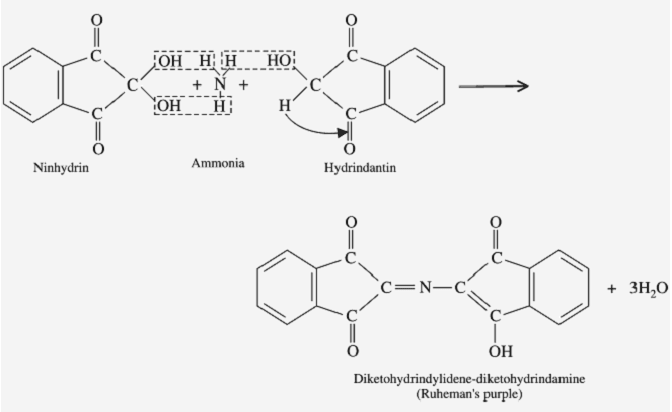
This reaction is a very sensitive reaction, and it is used for amino acid and imino acid identification.
When an amino acid (or) Imino acid reacts with the ninhydrin molecule, it gives color. When it gives a purple color (Rhumann’s Complex), the unknown sample is amino acids (which have a primary amine—NH₂), or it gives a yellow color—the unknown sample is an imino acid (-NH-).
Reaction with Edmann’s degradation
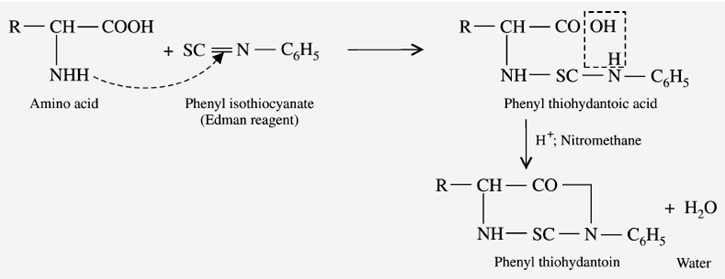
Erdmann’s reagent is “phenylisothiocyanate.” When amino acids react with Edmann’s reagent, it gives “phenyl thiohydantoic acid.” Finally, it turns into the cyclized form “phenyl thiohydantoin” (Edmann’s derivative).
The physical and chemical properties of amino acids give positive results after completing the reaction.
Other Important Chemical Tests of Amino Acids
Several other chemical reactions of amino acids are used in qualitative analysis and practical biochemistry. These tests are important for detecting specific types of amino acids in proteins.
- Xanthoproteic test detects aromatic amino acids such as tyrosine, tryptophan, and phenylalanine by forming yellow nitro derivatives when treated with concentrated nitric acid.
- Formol titration of amino acids (formol titration of glycine) uses formaldehyde to block the amino group, allowing accurate titration of the carboxyl group and determination of acid–base properties.
- Reactions with specific reagents are often used to characterize amino acids chemically and to study chemical properties of proteins and amino acids in biochemistry.
Physicochemical Properties of Proteins vs Amino Acids (Short Note)
Although this article focuses on the physical and chemical properties of amino acids, many students search for physicochemical properties of proteins as well. You can add a brief comparison note here to capture those queries while keeping the main focus on amino acids.
- Amino acids show physicochemical properties such as solubility, melting point, optical activity, acid–base behavior, and specific chemical reactions due to their amino and carboxyl groups.
- Proteins, which are polymers of amino acids, exhibit higher‑order physicochemical properties such as denaturation, coagulation, precipitation, and complex solubility behavior that depend on pH, temperature, and ionic strength.
- Understanding the physicochemical properties of amino acids helps in explaining many chemical properties of proteins, including their stability, folding, and interactions with other biomolecules.
Summary Points
- Amino acids show characteristic physical properties: crystalline solids, high melting points, water solubility, taste differences, and optical activity.
- Their chemical properties include amphoteric behavior, formation of zwitterions, acid–base reactions, and specific reactions such as the ninhydrin test, Sanger’s reaction, dansyl chloride reaction, and reaction with nitrous acid.
- These physical and chemical (physicochemical) properties of amino acids are fundamental to understanding protein chemistry, metabolism and many practical biochemistry tests.
Discover more from Biochemistry Den
Subscribe to get the latest posts sent to your email.