De novo lipogenesis converts glucose-derived acetyl-CoA from the TCA cycle into malonyl-CoA, which the fatty acid synthase (FASN) complex uses to build palmitate, the primary 16-carbon saturated fatty acid product.
This pathway operates mainly in the cytosol of hepatocytes, adipocytes, and lactating mammary gland cells, with the liver, kidney, and adipose tissue serving as the principal sites of de novo fatty acid synthesis in humans.
Triglycerides, built using a glycerol-3-phosphate backbone from glycolysis, remain the dominant lipid product and act as precursors for phospholipids and steroids.

Two essential inputs drive this anabolic process: acetyl-CoA as the carbon source and NADPH as the reducing power, with prerequisite ATP for the carboxylation step:
Steps in Saturated Fatty Acids Synthesis
1. Acetyl-CoA Transport And NADPH Generation
Acetyl-CoA is generated inside the mitochondrial matrix, primarily via pyruvate dehydrogenase, but fatty acid synthesis occurs in the cytosol, requiring a shuttle mechanism.
Citrate synthase condenses acetate with oxaloacetate to form citrate, which crosses into the cytosol via the citrate transporter and is then cleaved by ATP-citrate lyase (ACLY) back into acetyl-CoA and oxaloacetate.
ACLY has become a notable pharmacological target in recent metabolic and cardiovascular research due to its central role in lipogenesis.
The resulting oxaloacetate is reduced to malate and then converted to pyruvate via malic enzyme, a reaction that releases NADPH into the cytosol for fatty acid synthesis, with the pentose phosphate pathway (hexose monophosphate shunt) serving as the other major NADPH source
2. Malonyl-CoA Formation And ACC Regulation
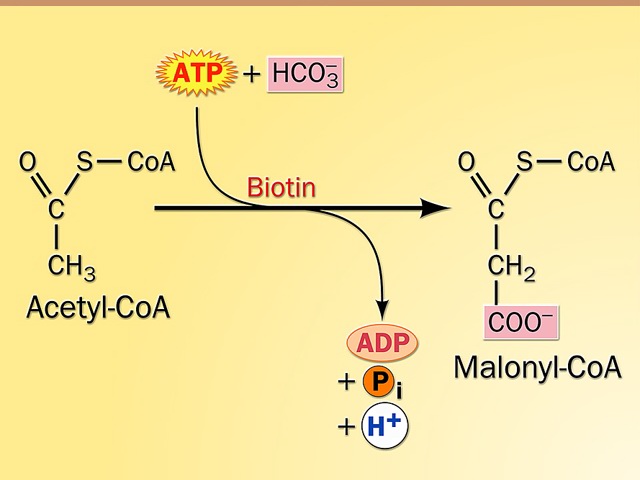
Acetyl-CoA carboxylase (ACC), a biotin-dependent enzyme, catalyzes the rate-limiting, committed step of fatty acid synthesis by carboxylating acetyl-CoA into malonyl-CoA using ATP and CO₂..
Two ACC isoforms exist physiologically: ACC1, cytosolic and lipogenic, and ACC2, mitochondrial-membrane-associated and involved in regulating fatty acid oxidation
| Regulation type | Activators | Inhibitors |
|---|---|---|
| Allosteric | Citrate (promotes active polymeric ACC) | Malonyl-CoA, palmitoyl-CoA (favor inactive monomer) |
| Hormonal/covalent | Insulin (activates phosphatase, dephosphorylates ACC) | Glucagon and epinephrine (PKA-mediated phosphorylation) |
| Transcriptional | SREBP-1c upregulation under fed/insulin state | Fasting, PPAR-alpha activation |
Long-term regulation depends largely on transcriptional control of ACC and FASN gene expression, with SREBP-1c recognized as the master transcription factor driving lipogenic gene expression in current metabolic literature.
Fatty Acid Synthase Complex Mechanism
The fatty acid synthase (FASN) complex is a homodimer containing seven catalytic domains plus the acyl carrier protein (ACP): acetyl-CoA-ACP transacylase, malonyl-CoA-ACP transacylase, beta-ketoacyl-ACP synthase, beta-ketoacyl-ACP reductase, beta-hydroxyacyl-ACP dehydratase, enoyl-ACP reductase, and palmitoyl thioesterase.
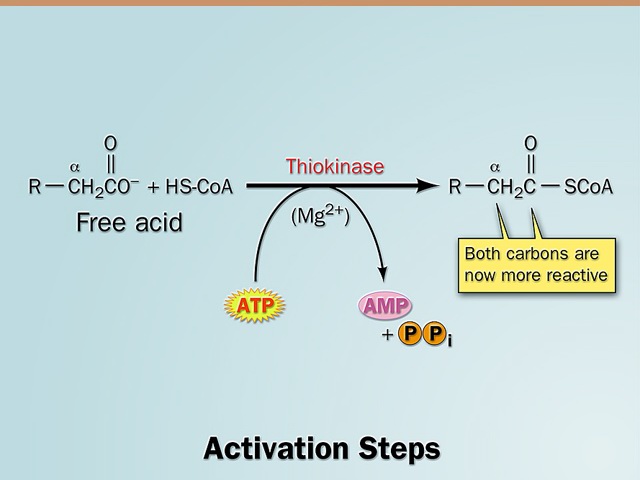
ACP’s phosphopantetheine arm shuttles the growing acyl chain between active sites across the dimer, and any fatty acid used downstream must first be activated as a fatty acyl-CoA
Each elongation cycle repeats four reactions:
- Condensation: acetyl-ACP and malonyl-ACP combine, releasing CO2 to form beta-ketoacyl-ACP
- Reduction: NADPH reduces the keto group to form beta-hydroxyacyl-ACP
- Dehydration: water is eliminated to form the enoyl-ACP intermediate
- Reduction: a second NADPH reduces the double bond, yielding a saturated acyl-ACP two carbons longer
This cycle repeats seven times total, consuming 8 acetyl-CoA, 7 ATP, and 14 NADPH molecules to yield one 16-carbon palmitate, 8 CoA, and 6 water molecules.
3. Fatty Acid Elongation Beyond Palmitate
Palmitate released by FASN can be further elongated in two distinct cellular compartments using different substrates and enzyme systems.
- Endoplasmic reticulum (microsomal system): ELOVL elongase enzymes add two-carbon units from malonyl-CoA using NADPH, extending chains from C10 upward, including stearate (C18) and longer very-long-chain fatty acids
- Mitochondria: a separate elongase system adds two-carbon units from acetyl-CoA to fatty acids up to about 14 carbons, with limited capacity beyond this length
Recent research also highlights a distinct mitochondrial fatty acid synthesis (mtFAS) pathway, separate from cytosolic FASN, that generates octanoyl-ACP for lipoic acid synthesis and supports mitochondrial respiratory function, an area of growing interest in physiopathology studies.
Steps in the Biosynthesis of Saturated Fatty Acids:
- Condensation:
- Acetate (2C) and malonate (3C), as acetyl-ACP and malonyl-ACP
- Releases the non-ACP-bound carboxyl group of malonate as CO₂
- Produces β-acetoacetyl-ACP (4C)
- Reduction:
- Produces β-hydroxybutyryl-ACP (4C), with the oxidation of NADPH² to NADP⁺
- Dehydration:
- Produces crotonyl-ACP (4C) with the release of water
- Reduction:
- Produces Butyryl-ACP with the oxidation of NADPH₂ to NADP⁺
- Repeat:
- Butyryl-ACP then enters into reaction 1 in the place of malonyl-ACP, undergoing the addition of another two carbons from acetate.
- The overall reaction uses 8 acetyl CoA, 14 NADPH, 14 H⁺, and 1 malonyl CoA to produce a 16-carbon palmitic acid.
Summary: Saturated Fatty Acid Biosynthesis
De novo synthesis of saturated fatty acids converts glucose-derived acetyl-CoA into palmitate through a cytosolic pathway requiring citrate transport, malonyl-CoA formation, and the multi-enzyme FASN complex.
The pathway is tightly regulated at the ACC step by allosteric effectors, hormones, and transcription factors like SREBP-1c and then extended beyond palmitate via ER and mitochondrial elongation systems.
- Substrate origin: Citrate shuttles mitochondrial acetyl-CoA to the cytosol, where ATP-citrate lyase regenerates acetyl-CoA and NADPH is supplied via malic enzyme and the pentose phosphate pathway
- Committed step: Acetyl-CoA carboxylase (ACC) converts acetyl-CoA to malonyl-CoA, regulated allosterically (citrate activates, malonyl/palmitoyl-CoA inhibit), hormonally (insulin activates, glucagon/epinephrine inhibit), and transcriptionally via SREBP-1c.
- Synthesis machinery: The FASN homodimer, using ACP-bound intermediates, runs seven cycles of condensation, reduction, dehydration, and reduction, consuming 8 acetyl-CoA, 7 ATP, and 14 NADPH to produce one palmitate molecule.
- Chain elongation: ER-based ELOVL enzymes extend palmitate using malonyl-CoA up to very-long-chain fatty acids, while mitochondrial elongases add acetyl-CoA-derived units only up to about 14 carbons
- Emerging area: A distinct mitochondrial fatty acid synthesis (mtFAS) pathway produces octanoyl-ACP for lipoic acid synthesis, supporting respiratory chain function and drawing increasing research interest
| Stage | Key enzyme/process | Product |
|---|---|---|
| Acetyl-CoA transport | Citrate synthase, ACLY | Cytosolic acetyl-CoA |
| Carboxylation | Acetyl-CoA carboxylase (ACC) | Malonyl-CoA |
| Chain assembly | Fatty acid synthase (FASN) complex | Palmitate (16C) |
| Elongation | ELOVL (ER) / mitochondrial elongase | Stearate, VLCFAs, up to 14C (mitochondria) |
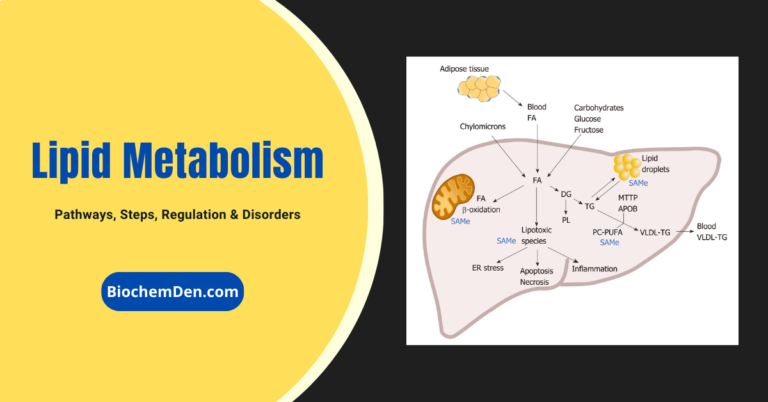
Lipogenesis (building fat) is only half the story. To see how the body burns fat during fasting, check out our master guide to Lipid Metabolism.
Discover more from Biochemistry Den
Subscribe to get the latest posts sent to your email.