Mutarotation is a key concept in carbohydrate chemistry and biochemistry that every student of life sciences, pharmacy, and chemistry must understand clearly. It connects the stereochemistry of sugars with their behavior in solution, their role as reducing agents, and their functions in metabolism and industry.
This article explains mutarotation in a clear, student-friendly way. It covers the definition, structural basis, mechanism, factors affecting mutarotation, methods used to monitor it, biological importance, industrial applications, and common exam questions, with special emphasis on D-glucose as the standard example.
What Is Mutarotation?
Mutarotation is the change in optical rotation that occurs when the alpha and beta anomeric forms of a reducing sugar interconvert in solution until a constant equilibrium value is reached.
When a pure sample of a sugar such as D-glucose is dissolved in water, its optical rotation does not remain fixed. Instead, the observed rotation gradually changes with time and finally becomes constant. This happens because the sugar molecules convert from one anomeric form to the other through the open-chain form.
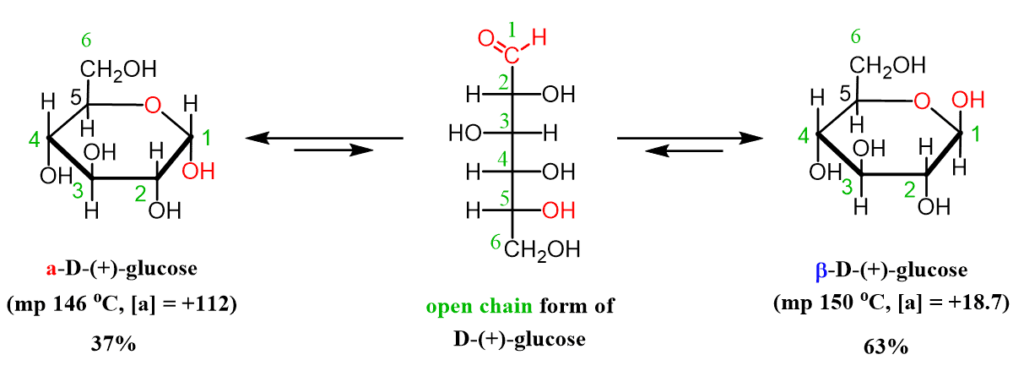
In simple terms, mutarotation means that the same sugar can exist in two cyclic forms, alpha and beta, and these forms change into each other in solution. Since the alpha and beta forms rotate plane-polarized light differently, the overall optical rotation of the solution changes until equilibrium is established.
An exam-ready definition is as follows: mutarotation is the process by which the alpha and beta anomeric forms of a monosaccharide interconvert in solution through reversible opening of the cyclic hemiacetal or hemiketal ring to the open-chain form and subsequent ring closure in either configuration at the anomeric carbon, causing a gradual change in optical rotation until equilibrium is reached.
Historical Background
Mutarotation was recognized during early studies of carbohydrate chemistry when chemists observed that the optical rotation of freshly prepared sugar solutions changed with time before becoming constant. This observation helped establish that sugars do not exist in solution as a single rigid structure but as an equilibrium mixture of different forms.
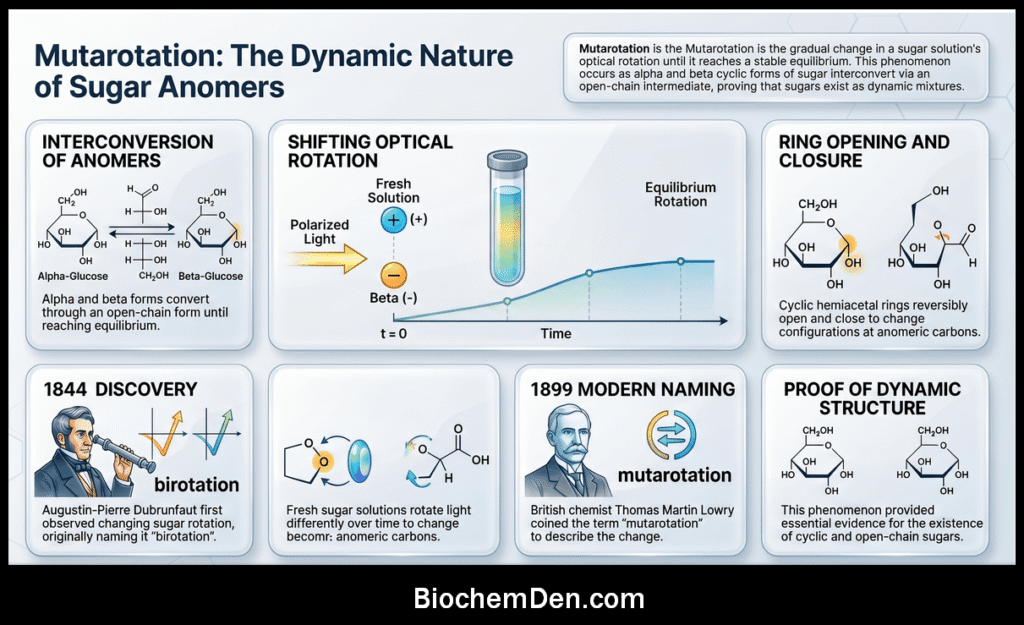
The historical importance of mutarotation lies in the fact that it provided evidence for cyclic and open-chain forms of sugars and helped scientists understand the concept of anomers. It also laid the foundation for modern carbohydrate chemistry and stereochemistry.
Mutarotation was discovered by the French chemist Augustin-Pierre Dubrunfaut in 1844. He observed that the optical rotation of a freshly prepared aqueous sugar solution changes over time until it reaches a stable equilibrium.
A quick look at the history:
- Original Name: Dubrunfaut originally named this phenomenon “birotation” (or sometimes multirotation).
- Current Name: The term “mutarotation” was later coined by British chemist Thomas Martin Lowry in 1899 to better describe the changing rotation of the molecules.
- What it is: It describes the structural change of cyclic carbohydrates in solution (like glucose) as they convert between their alpha and beta anomers.
Structural Basis of Mutarotation
Anomeric Carbon and Anomers
Many monosaccharides can form cyclic structures when a carbonyl group reacts with a hydroxyl group within the same molecule. In aldoses such as glucose, the aldehyde group reacts with an alcohol group to form a cyclic hemiacetal. In ketoses such as fructose, the ketone group reacts with an alcohol group to form a cyclic hemiketal.
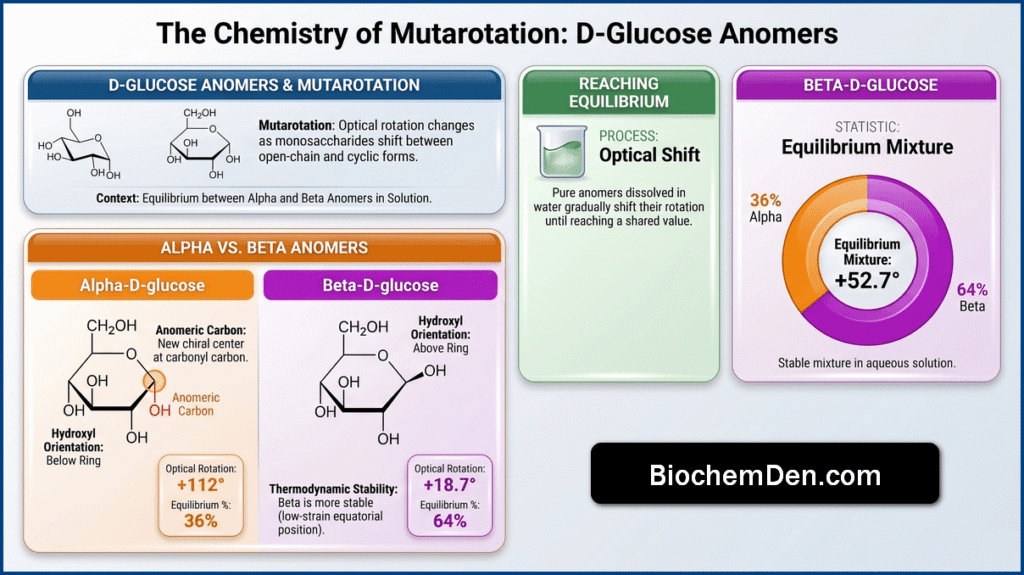
During cyclization, a new chiral center is created at the carbonyl carbon. This carbon is called the anomeric carbon. Because this new chiral center can adopt two different configurations, two cyclic forms are possible, called anomers.
The two anomers are:
- Alpha anomer: the hydroxyl group on the anomeric carbon is oriented below the plane of the ring in the conventional Haworth projection of D-sugars.
- Beta anomer: the hydroxyl group on the anomeric carbon is oriented above the plane of the ring in the conventional Haworth projection of D-sugars.
In D-glucose, the alpha form has the anomeric hydroxyl group in the axial position, while the beta form has it in the equatorial position. These two forms differ only in configuration at the anomeric carbon, so they are known as anomers.
Hemiacetal, Hemiketal, Pyranose, and Furanose
A hemiacetal is formed when an aldehyde reacts with an alcohol. A hemiketal is formed when a ketone reacts with an alcohol. These reactions allow monosaccharides to exist in cyclic forms.
Depending on the ring size formed during cyclization, sugars may exist as the following:
- Pyranose forms: six-membered rings
- Furanose forms: five-membered rings
Glucose mainly exists as glucopyranose in solution, whereas ribose and fructose may exist in furanose as well as pyranose forms. The ability of sugars to cycle between open-chain and cyclic forms is the structural basis of mutarotation.
Mutarotation of D-Glucose
D-glucose is the classic example used to explain mutarotation. When pure alpha-D-glucose is dissolved in water, the observed optical rotation starts at a higher value and gradually decreases. When pure beta-D-glucose is dissolved in water, the optical rotation starts at a lower value and gradually increases. In both cases, the final equilibrium rotation becomes the same.
At equilibrium in aqueous solution, D-glucose exists mainly as a mixture of about 36 percent alpha-D-glucopyranose and 64 percent beta-D-glucopyranose. The beta form predominates because it is more thermodynamically stable.
The commonly remembered optical rotation values for glucose are:
- Alpha-D-glucose: about +112°
- Beta-D-glucose: about +18.7°
- Equilibrium mixture: about +52.7°
These values are frequently asked in chemistry and biochemistry exams because they clearly demonstrate the phenomenon of mutarotation.
Why Beta-D-Glucose Predominates
The beta anomer of D-glucose is more stable than the alpha anomer because the anomeric hydroxyl group occupies an equatorial position in the chair conformation. This arrangement reduces steric hindrance and makes the structure energetically more favorable.
In the alpha anomer, the anomeric hydroxyl group is axial, which creates greater steric strain and less stability. As a result, when equilibrium is established in aqueous solution, the beta form is present in a greater proportion than the alpha form.
This is a good example of the difference between thermodynamic stability and kinetic interconversion. Even though both alpha and beta forms are present, the more stable beta form dominates the equilibrium mixture.
Mechanism of Mutarotation
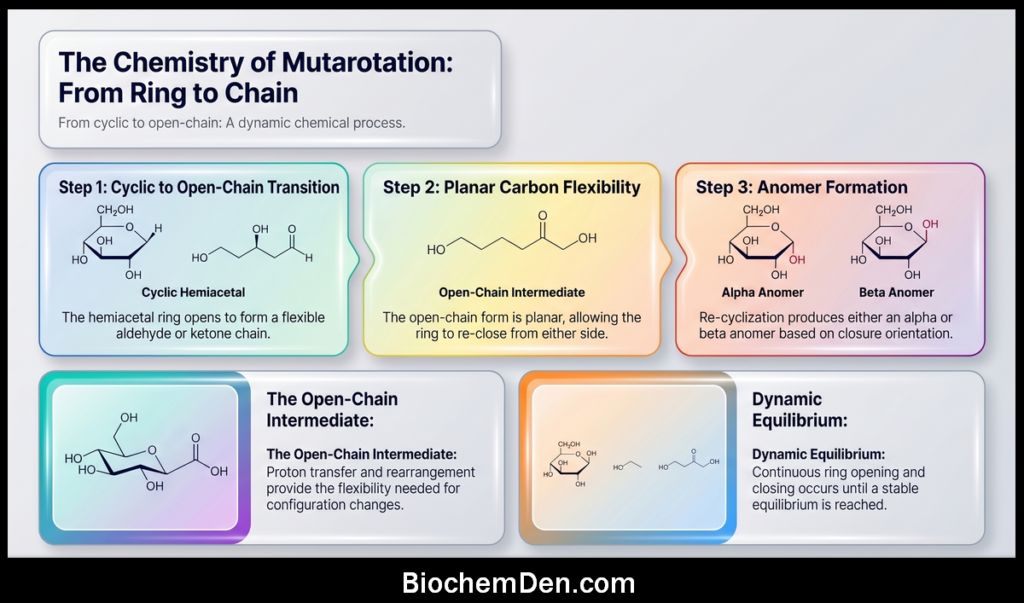
The mechanism of mutarotation involves interconversion between the alpha and beta forms through the open-chain form of the sugar.
- Step 1: Ring Opening: The cyclic hemiacetal or hemiketal ring opens to form the open-chain aldehyde or ketone form. This step is essential because direct conversion of one anomer into the other cannot occur without opening the ring.
- Step 2: Formation of an Intermediate: After ring opening, proton transfer and rearrangement occur. This may involve an enediol-like intermediate. The important point for students is that the open-chain form allows flexibility at the carbon that will become the anomeric carbon during ring closure.
- Step 3: Configuration Change: Because the open-chain form is planar at the carbonyl carbon, ring closure can occur from either side. This allows the formation of either the alpha or beta anomer.
- Step 4: Ring Closure: The open-chain form cyclizes again to give the cyclic hemiacetal or hemiketal structure. If the ring closes in one orientation, the alpha anomer is produced; if it closes in the opposite orientation, the beta anomer is produced.
Repeated ring opening and ring closing allow continuous interconversion between alpha and beta forms until equilibrium is reached.
Mutarotation and Catalysis
The mechanism of mutarotation is fundamentally driven by ring-chain tautomerism, which involves an equilibrium between the cyclic and open-chain forms of a carbohydrate.
For mutarotation to occur, the sugar must be a reducing sugar, meaning it possesses a free hemiacetal or hemiketal group at its anomeric carbon that is capable of opening.
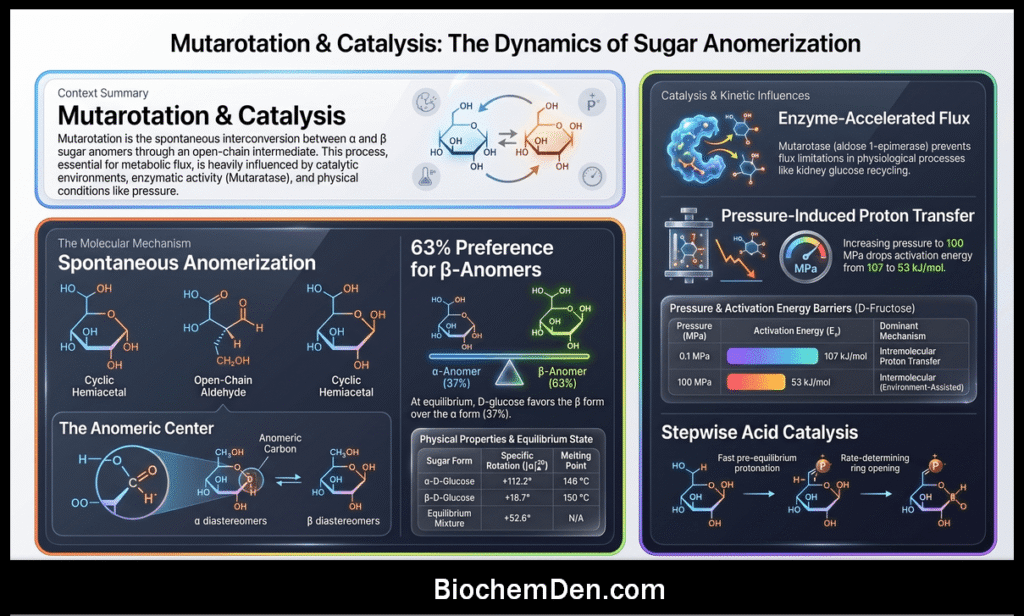
When a cyclic sugar like glucose dissolves in water, the ring structure undergoes the following steps:
- Ring Opening: The cyclic hemiacetal opens to form a straight-chain aldehyde intermediate.
- Bond Rotation: Once in the open-chain form, a 180° rotation occurs around the C1–C2 single bond, which reorients the carbonyl (C=O) group either pointing up or down.
- Ring Closure: The ring recloses via a nucleophilic attack by the C5-hydroxyl group onto the aldehydic C1 carbon, generating either the alpha ($\alpha$) or beta ($\beta$) anomeric cyclic form depending on the orientation of the carbonyl group prior to closure.
Acid-Base Catalysis and Proton Transfers
Mutarotation is a general acid-base catalyzed reaction that is significantly accelerated by the presence of acidic or basic conditions.
At the molecular level, the mechanism is characterized by two essential proton transfers: the protonation of the ring oxygen, which facilitates the breaking of the carbon-oxygen ether linkage, and the deprotonation of the C-1 hydroxyl group.
Chemists have debated the exact timing of these proton transfers, leading to two major mechanistic models:
- The Pedersen Mechanism (Stepwise): This widely accepted model proposes that the proton transfers occur consecutively. In the acid-catalyzed reaction, a fast pre-equilibrium protonation of the ring oxygen is followed by a rate-determining step where the hydroxyl proton is removed simultaneously with the breaking of the ether linkage. Studies in mixed solvents (like dimethylsulfoxide and water) suggest this stepwise proton-catalyzed mechanism occurs without the direct participation of water molecules in the transition state.
- The Eigen Mechanism (Concerted): Alternatively, it has been proposed that the proton transfers may happen via a concerted mechanism, where multiple molecules form a cyclic, hydrogen-bonded transition state. Research indicates that when mutarotation is catalyzed solely by the solvent (water), the reaction may utilize a cyclic-concerted mechanism involving approximately three water molecules.
Intramolecular vs. Intermolecular Pathways
Depending on the environment, the specific transfer of the proton between the anomeric hydroxyl group and the ring oxygen can be either intramolecular or intermolecular.
- In the gas phase, mutarotation relies on a direct, intramolecular proton exchange.
- In the liquid phase, solvent molecules typically assist the proton transfer, making it an intermolecular process.
- In highly concentrated or supercooled states near the glass transition temperature, mutarotation can be facilitated by neighboring sugar molecules instead of the solvent, resulting in a stronger sugar-sugar intermolecular interaction that is further accelerated under elevated pressure.
Enzymatic Mechanism (Mutarotase)
While mutarotation occurs spontaneously in aqueous solutions over several minutes, biological systems rely on the enzyme mutarotase to massively enhance the reaction rate.
Mutarotase binds the monosaccharide by replacing the sugar’s hydrogen bonds to water with more favorable hydrogen bonds to the protein.
X-ray crystallography has revealed that four specific amino acid residues—His96, His170, Asp243, and Glu304—are intimately involved in binding the sugar and catalyzing the structural interconversion.
The overall three-dimensional structure of the enzyme does not change upon binding the substrate, and the active site’s spatial arrangement is highly conserved across species.
Kinetic and Thermodynamic Aspects
Mutarotation is controlled by both kinetic and thermodynamic factors.
Kinetic Aspect
The cyclic forms of sugars are kinetically stable. This means they do not convert into the open-chain form very easily under ordinary conditions. There is an energy barrier associated with ring opening.
Thermodynamic Aspect
Once interconversion occurs, the final proportion of alpha and beta forms depends on their relative thermodynamic stabilities. In glucose, the beta anomer is more thermodynamically stable, so it is present in greater amount at equilibrium.
Thus, the mutarotation process reflects the balance between:
- The rate at which ring opening and closing occur
- The relative stability of the alpha and beta anomers
Factors Affecting Mutarotation
Several factors influence the rate and equilibrium of mutarotation.
- Temperature: Increasing temperature increases the rate of mutarotation. Higher temperature provides more energy to overcome the barrier for ring opening, so equilibrium is reached faster.
- pH: Acidic and basic conditions can catalyze mutarotation. In an acidic medium, protonation helps ring opening. In basic medium, deprotonation can also facilitate interconversion. Therefore, mutarotation generally occurs faster in the presence of acids or bases than in neutral conditions.
- Solvent: Polar protic solvents such as water facilitate mutarotation because they stabilize polar intermediates and transition states. Nonpolar solvents inhibit mutarotation because they do not support ring opening effectively.
- Concentration: At lower sugar concentrations, mutarotation may proceed faster because intermolecular hydrogen bonding between sugar molecules is reduced. At higher concentrations, these interactions may slow down the process.
- Structure of the Sugar: The stereochemistry and ring structure of a sugar strongly influence mutarotation. Different monosaccharides show different equilibrium ratios and different rates of interconversion.
Sugars That Show and Do Not Show Mutarotation
Sugars That Show Mutarotation
Mutarotation is shown by reducing sugars that possess a free hemiacetal or hemiketal group. Examples include:
- Glucose
- Fructose
- Galactose
- Mannose
- Ribose
- Xylose
These sugars can open their rings and reform them, allowing interconversion between alpha and beta forms.
Sugars That Do Not Show Mutarotation
Non-reducing sugars generally do not show mutarotation because their anomeric carbon is locked in a glycosidic bond and cannot open freely.
Important examples include:
- Sucrose
- Most oligosaccharides in which the anomeric carbons are involved in glycosidic linkage
- Many polysaccharides, where free ring opening of the repeating units is not possible in the same way
This is an important exam point: a sugar must have a free anomeric carbon to undergo mutarotation.
Measurement and Monitoring of Mutarotation
Several analytical techniques can be used to monitor mutarotation.
- Polarimetry: Polarimetry is the most classical and most important method. Since alpha and beta anomers have different specific rotations, a polarimeter can track the change in optical rotation with time. This is the direct experimental demonstration of mutarotation.
- NMR Spectroscopy: Proton NMR can distinguish alpha and beta anomers because their anomeric protons appear at different chemical shifts and show different coupling patterns. NMR is a powerful method for determining the ratio of the two forms.
- HPLC: High-performance liquid chromatography can separate alpha and beta anomers and estimate their proportions from the peak areas.
- IR Spectroscopy: Infrared spectroscopy may detect differences in vibrational modes between alpha and beta forms, especially in the anomeric region.
- Titration and Other Methods: Changes in acid-base properties during interconversion can sometimes be followed by titration methods. These approaches are less commonly emphasized in student-level discussions but may be useful in research settings.
Biological Importance of Mutarotation
Mutarotation is not just a theoretical concept. It has real biological significance.
- Role in Carbohydrate Metabolism: Sugars in living systems often need to switch between cyclic and open-chain forms during metabolism. Mutarotation allows this dynamic equilibrium, which is essential for many biochemical reactions.
- Availability of the Correct Anomer for Enzymes: Many enzymes recognize only one anomer of a sugar. Mutarotation helps maintain equilibrium between alpha and beta forms, ensuring that the correct anomer is available for enzyme action.
- Membrane Transport: Transport proteins often recognize sugars in specific cyclic conformations. Mutarotation helps provide the required form for transport across membranes.
- Glycolysis and Related Pathways: During pathways such as glycolysis, sugars undergo multiple transformations. Interconversion between cyclic and open-chain forms is important for these reactions, and mutarotation contributes to that flexibility.
- Protein Recognition: Carbohydrate-binding proteins may recognize different anomeric forms. The equilibrium produced by mutarotation allows proper interaction between sugars and biological molecules.
- Reducing Action and Maillard Reaction: When the ring opens during mutarotation, the sugar can form an open-chain aldehyde or ketone. This free carbonyl group makes reducing sugars chemically reactive and allows them to participate in reactions such as Maillard browning.
- Pentose Sugar Equilibrium: Pentose sugars such as ribose and deoxyribose can exist in equilibrium between furanose and pyranose forms. Mutarotation contributes to these equilibria, which are important in biological systems.
Industrial and Practical Applications of Mutarotation
Mutarotation also has practical applications in food science, biotechnology, and analytical chemistry.
- Food Industry: Mutarotation affects sweetness, texture, and stability in sugar-containing foods. It is relevant in syrups, confectionery products, and processed foods where sugar composition changes over time.
- Honey Adulteration Testing: Changes in optical rotation can be used in the analysis of honey. Mutarotation data may help in detecting dilution, adulteration, or differences in authenticity.
- Fruit Ripening Studies: Changes in sugar composition during ripening can be studied by monitoring mutarotation behavior.
- Industrial Fermentation: In fermentation industries, microorganisms consume sugars in different forms. Understanding mutarotation helps improve control of fermentation conditions and substrate availability.
- High-Fructose Corn Syrup Production: Mutarotation affects the behavior and analysis of glucose and fructose during sweetener production processes. This is important for optimizing industrial carbohydrate conversions.
Discovery and Scientific Significance
The study of mutarotation played a major role in establishing the modern understanding of sugar chemistry. It showed that monosaccharides are dynamic molecules capable of existing in multiple forms in solution. It also supported the concepts of cyclic structure, anomerism, stereochemistry, and equilibrium.
Because of this, mutarotation is more than a textbook term. It is a concept that connects structure, reactivity, metabolism, and practical chemistry in a single phenomenon.
Important Terms to Remember
- Anomer: one of two stereoisomers of a cyclic sugar differing only at the anomeric carbon
- Anomeric carbon: the carbonyl carbon that becomes a new chiral center after cyclization
- Epimer: stereoisomers differing at only one chiral center
- Hemiacetal: product formed by reaction of an aldehyde with an alcohol
- Hemiketal: product formed by reaction of a ketone with an alcohol
- Pyranose: six-membered cyclic form of a sugar
- Furanose: five-membered cyclic form of a sugar
- Glycosidic bond: bond involving the anomeric carbon of a sugar and another group
- Tautomerization: rearrangement involving movement of a proton and a double bond
- Specific rotation: optical rotation normalized for path length and concentration
Quick Revision Notes
- Mutarotation is the change in optical rotation due to interconversion of alpha and beta anomers.
- It occurs in reducing sugars that have a free anomeric carbon.
- The process involves ring opening, formation of the open-chain form, and ring closing.
- D-glucose shows mutarotation clearly.
- In aqueous solution, D-glucose exists as about 36 percent alpha form and 64 percent beta form.
- Beta-D-glucose is more stable because the anomeric hydroxyl group is equatorial.
- Temperature, pH, solvent, concentration, and structure affect mutarotation.
- Polarimetry is the classical method for measuring mutarotation.
- Mutarotation is biologically important in metabolism, transport, enzyme action, and protein recognition.
- Non-reducing sugars such as sucrose do not show mutarotation because their anomeric carbon is locked.
Frequently Asked Questions About Mutarotation
What is mutarotation in simple words?
Mutarotation is the gradual change in optical rotation of a sugar solution caused by the interconversion of the alpha and beta forms of the same sugar. It happens when the sugar ring opens to the open-chain form and then closes again, producing a mixture of anomers at equilibrium.
Why does mutarotation occur?
Mutarotation occurs because many monosaccharides can exist in both cyclic and open-chain forms in solution. When the ring opens, the configuration at the anomeric carbon can change. On ring closure, the sugar may form either the alpha or beta anomer, leading to a gradual change in optical rotation.
Which sugars show mutarotation?
Mutarotation is shown by reducing sugars that have a free anomeric carbon and can open their rings in solution. Common examples include glucose, fructose, galactose, mannose, ribose, and xylose. These sugars interconvert between alpha and beta forms through the open-chain structure.
Which sugars do not show mutarotation?
Non-reducing sugars generally do not show mutarotation because their anomeric carbon is involved in a glycosidic bond and cannot open freely. Sucrose is the standard example. Many oligosaccharides and polysaccharides also do not exhibit overall mutarotation for the same structural reason.
Why is D-glucose the common example of mutarotation?
D-glucose is the most commonly used example because its alpha and beta forms are well studied and clearly demonstrate changes in optical rotation over time. It also forms a stable equilibrium mixture in water, making it ideal for explaining anomerism, ring opening, and mutarotation in biochemistry.
Why is beta-D-glucose more stable than alpha-D-glucose?
Beta-D-glucose is more stable because the hydroxyl group on the anomeric carbon is in the equatorial position, which reduces steric hindrance in the chair conformation. In alpha-D-glucose, that hydroxyl group is axial, creating more strain. This is why beta-D-glucose predominates at equilibrium.
How is mutarotation measured?
Mutarotation is most commonly measured by polarimetry, which tracks the change in optical rotation of a sugar solution over time. Other methods include NMR spectroscopy, HPLC, IR spectroscopy, and titration techniques. These methods help determine the ratio of alpha and beta anomers as equilibrium is approached.
Why is mutarotation biologically important?
Mutarotation is biologically important because it allows sugars to interconvert between forms needed for enzyme reactions, membrane transport, and metabolic pathways. It also helps maintain the proper anomeric form for recognition by proteins and contributes to the reducing properties of sugars in biochemical reactions.
What happens during the mechanism of mutarotation?
During mutarotation, the cyclic sugar first opens to form the open-chain aldehyde or ketone form. Proton transfer and rearrangement then occur, and the molecule closes again to produce either the alpha or beta anomer. Repeated ring opening and closing continue until equilibrium between the two forms is established.
What is the equilibrium composition of D-glucose during mutarotation?
In aqueous solution, D-glucose reaches an equilibrium mixture containing about 64% beta-D-glucopyranose and 36% alpha-D-glucopyranose. The beta form is more abundant because it is thermodynamically more stable. This equilibrium composition is one of the most important facts to remember in mutarotation.
What factors affect the rate of mutarotation?
The rate of mutarotation is affected by temperature, pH, solvent, sugar concentration, and molecular structure. Higher temperature usually speeds up mutarotation. Acidic or basic conditions can catalyze ring opening, while polar solvents like water facilitate interconversion between the alpha and beta forms.
Is mutarotation seen only in glucose?
No, mutarotation is not limited to glucose. It is a general property of many reducing monosaccharides and some other carbohydrates that have a free anomeric carbon. Sugars such as fructose, galactose, mannose, ribose, and xylose also undergo mutarotation by interconverting between cyclic anomeric forms.
Conclusion
Mutarotation is one of the most important concepts in carbohydrate chemistry because it explains how sugars behave dynamically in solution. It demonstrates that monosaccharides are not fixed structures but exist in equilibrium between alpha and beta anomeric forms through the open-chain state.
A proper understanding of mutarotation helps students connect several major ideas in biochemistry, including stereochemistry, optical activity, sugar reactivity, reducing action, metabolism, and industrial carbohydrate applications. For exam preparation as well as conceptual understanding, mutarotation of D-glucose remains the best model for learning this topic thoroughly.
Discover more from Biochemistry Den
Subscribe to get the latest posts sent to your email.